SuperStream: Australia's Public Standard and Private Superannuation Network
A detailed guide to Australia's SuperStream system: its regulatory origins, data and money flows, gateways, clearinghouses, public infrastructure, commercial operators and Payday Super changes in 2026.
Research backgrounder · Updated 11 November 2026
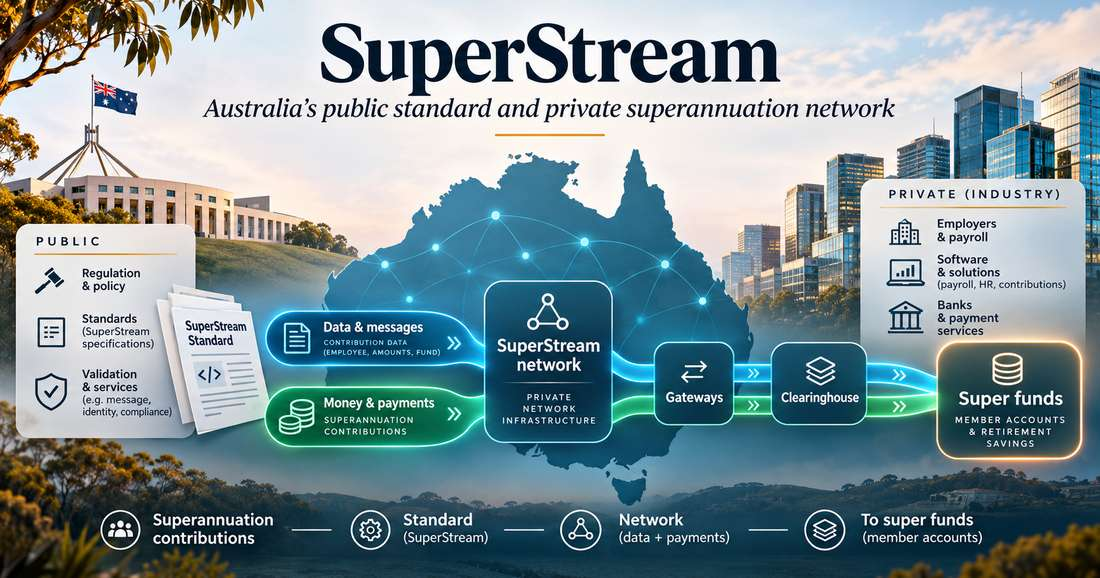
SuperStream is Australia's mandatory framework for exchanging superannuation contribution and rollover information electronically, together with rules for associated payments. It is not a single government website, bank, clearinghouse or API. The Commonwealth specifies the standards and operates central regulatory and validation services; industry-owned infrastructure carries much of the traffic, and commercial businesses package the system into services used by employers, funds and software developers.
That distinction matters. An employer can satisfy SuperStream through a payroll product, fund portal, clearinghouse, or suitable direct-payment-and-messaging arrangement. A gateway moves information; a clearinghouse can coordinate information and money; a super fund actually receives and allocates the contribution.
Origins: a public standard, not a public utility
The Commonwealth's Stronger Super reforms, announced in 2010, sought to replace fragmented, error-prone and often manual fund administration. The ATO developed the Superannuation Data and Payment Standards under the Superannuation Data and Payment Standards 2012. Electronic contributions and rollovers were progressively mandated. The ATO's technical overview distinguishes contribution standards, rollover standards and related business-to-government services. The Gateway Network Governance Body's history traces the network's origin.
The resulting arrangement is a form of regulated interoperability: participants must conform to common formats and processes, but much of the network and its retail access are privately operated. The standard is not the same thing as the Superannuation Guarantee (SG) law: SG determines who owes what and when; SuperStream determines how the payment and the information needed to allocate it are exchanged.
The organisations and responsibilities
| Layer | Operator/governance | What it does |
|---|---|---|
| Superannuation law and SG enforcement | Commonwealth, principally ATO | Contribution obligations, collection and compliance |
| SuperStream data and payment standards | Commonwealth/ATO | Data definitions, protocols, validation, responses and accepted payment mechanisms |
| Fund Validation Service and supporting registers | ATO | Authoritative data about regulated fund products, identifiers and destination information |
| Superannuation Transaction Network (STN) | Federated, industry-operated gateways | Securely routes and exchanges SuperStream data messages |
| Gateway Network Governance Body (GNGB) | Industry-owned not-for-profit | Network governance, entry arrangements and operational coordination |
| Gateway operator | Commercial firms and industry/fund-owned firms | Runs an STN endpoint; translates, validates, routes and delivers messages |
| Clearinghouse | Mostly commercial or super-fund-provided | Accepts a contribution batch and coordinates data and payments to many funds |
| Payroll and employer software | Commercial providers or in-house | Calculates contributions, prepares instructions, submits and monitors them |
| Payment rails | Banking/payment industry, with public settlement infrastructure | Moves money separately from the SuperStream data messages |
| Receiving fund or administrator | Industry, retail, corporate, public-sector or self-managed fund | Matches messages/payments, allocates to members and handles returns/errors |
The GNGB was established in 2016. It is not the ATO and does not run a single central switch. It oversees the federated STN under agreements among gateway operators. Its gateway explanation and operator framework explain routing, conformance, security and participation requirements. Gateway operators sign an MoU, satisfy entry requirements and pay applicable fees; GNGB membership and accredited operation are related but distinct concepts. The GNGB's public member list includes fund-sector, software and gateway interests.
A contribution from beginning to end
Consider an employer making contributions for three workers at three different funds.
- Establish the obligation. Payroll or another process determines the liable workers, contribution amounts and pay period. Applicable contractors may be employees for SG purposes even when they are contractors for other legal purposes.
- Resolve destinations. The provider gathers fund identifiers and the workers' membership details, using fund choice or applicable stapled-fund processes. For an APRA-regulated fund the Unique Superannuation Identifier (USI) identifies the product; a self-managed super fund (SMSF) instead needs its ABN, banking details and an Electronic Service Address (ESA).
- Prepare a message. The sender creates the prescribed electronic contribution data identifying employer, fund, member, contribution types, amounts and payment references. Software may use a payroll-derived file or integrate directly with a service provider.
- Route the data. A gateway sends the message through the STN to the fund's receiving gateway or administrator. Systems validate formats and exchange response or error messages.
- Move the money. Funds travel through banking/payment infrastructure, often via a clearinghouse collecting a single employer payment and redistributing it. A SuperStream gateway message is not itself a funds transfer.
- Match and allocate. A payment reference (PRN) enables matching of payment and contribution data. A successful bank transfer does not alone prove the fund has allocated the correct member contribution.
- Handle exceptions. Rejections, incorrect membership details, wrong destinations, late or unmatched money and refunds require remediation and sometimes resubmission. An employer needs evidence of receipt, not just evidence of initiating a payment.
The GNGB description of the STN explains the separate payment and data paths, while the ATO Contributions v3 materials specify message and response implementation requirements. A Creative Workplaces guide notes that fund portals, clearinghouses and direct EFT/BPAY alongside compliant messaging may be options: paying by EFT alone is not equivalent to sending the required SuperStream data.
The technical architecture beneath the interfaces
SuperStream is not just an uploaded spreadsheet. The standards encompass a structured reporting payload, rules for transmitting it, payment specifications and response/error handling. The technical stack includes XBRL business facts, message implementation guides and ebMS3/AS4 messaging profiles, building on Australia's Standard Business Reporting infrastructure. The SBR ebMS3 technical resources describe the government-side framework; the ATO contribution standard provides schedules, sample messages, schematron and conformance material.
A common employer-facing interchange is the SuperStream Alternative File Format (SAFF). This is a useful ingest format for providers, not the entire wire protocol. A CSV/file-upload clearinghouse can convert upstream input into compliant downstream messages. Conversely, a software provider can integrate with a gateway's own API without implementing the complete network protocol itself.
The ATO's Fund Validation Service (FVS) distributes fund/product information used by software and intermediaries. Supporting validation and alias tables help route transactions to the correct gateways and SMSF messaging providers; see ATO validation services. These are controlled industry/regulatory facilities, not a promise of unauthenticated, public, self-service APIs.
An SMSF's ESA is particularly easy to misunderstand. It is an address/alias for a compliant electronic messaging provider, not an email address or bank account. Different providers may support contributions, rollovers or both; an employer must still separately transfer funds to the SMSF bank account. See the ATO's SMSF ESA guidance.
Who actually operates the gateway network?
The GNGB maintains an accredited operator directory. Its current listing includes Wrkr, GBST, Apex Group (SuperConnector), MessageXchange, Oban, Ozedi, Precision Administration, Westpac Institutional Bank (QuickSuper), SuperChoice and Rockfast. These are gateway/network operators, not ten equivalent consumer clearinghouses. Some primarily serve fund administrators or other enterprise counterparties; some sell services to payroll developers; some provide employer-facing clearinghouses.
Distinguish three separate claims when evaluating a vendor: (a) it is an accredited network operator; (b) it supplies a clearinghouse or compliant employer-facing product; (c) it provides an externally accessible API under commercially obtainable terms. One does not establish the other.
The commercial and industry-owned providers
Wrkr / ClickSuper / Wrkr PAY. Wrkr offers gateway and clearinghouse capabilities, payroll integrations, onboarding, validation and STP-related services. Its public developer-facing pitch explicitly advertises an API and support for manual entry, CSV and payroll files. ClickSuper Pty Ltd, trading as Wrkr PAY, is a wholly owned subsidiary of Wrkr Ltd; its June 2026 financial services guide and PDS identify the licensed issuer. ClickSuper is also the underlying service in some branded super-fund clearinghouse arrangements. The AustralianSuper clearinghouse disclosure illustrates that branded distribution can sit over Wrkr/ClickSuper or other infrastructure.
Westpac / QuickSuper. QuickSuper is a Westpac-owned and -operated clearinghouse/gateway offering, with online, file and API access, and an emphasis on NPP real-time payment and matching. It is distributed to employers via various super funds as well as direct banking relationships. The Commonwealth Superannuation Corporation's QuickSuper offering demonstrates the white-label/channel pattern: eligibility and pricing can depend on a fund relationship, and a no-cost employer clearinghouse may still be commercially underpinned by a bank provider.
SuperChoice / SuperPay / PayClear. SuperChoice combines clearinghouse products, gateway access, STP, stapled-fund/onboarding tools and fraud monitoring. Its SuperPay clearinghouse is listed on the ATO product register. SuperChoice Services is an authorised representative of related PayClear Services Pty Ltd, an AFSL holder, according to its own corporate disclosure. SuperChoice has a role as gateway operator and offers integration to digital service providers; precise APIs, volumes, onboarding and pricing require commercial enquiry.
Beam / Precision Administration / Australian Retirement Trust. Beam provides embedded superannuation clearinghouse technology for payroll-software providers rather than presenting only as a stand-alone employer website. It belongs to the Australian Retirement Trust group, and its operator/issuer is Precision Administration Services Pty Ltd; the Beam privacy statement documents that ownership and product scope. This is an example of fund-owned commercial infrastructure: not Commonwealth-operated, and not merely an internal tool for members of the parent fund. Beam's knowledge base describes payment receipt/forwarding periods, illustrating why clearinghouses introduce timing considerations.
MessageXchange. MessageXchange sells secure business messaging, SuperStream contribution and rollover connectivity, broader B2B messaging, STP and payment integration. Its public product description mentions direct debit, NPP and PayTo, as well as ebMS/AS4 gateway capabilities. Its positioning is strongly infrastructure/integration-oriented; availability and terms of a lightweight self-service contribution product should not be presumed.
Ozedi and Oban. Ozedi describes business-to-business, government and superannuation messaging services, including STP and SuperStream. Oban appears in the GNGB accredited operator list and ATO service-provider listings. These firms are more naturally considered network/service-provider candidates than interchangeable clearinghouses for occasional employer payments.
GBST, Apex, Rockfast and other fund-side operators. These appear in the accredited operator directory but have different customer bases and service mixes, often involving fund administration, gateway endpoints and enterprise integration. Accreditation alone does not imply a retail signup portal. Precision, mentioned above, is both a GNGB operator and the company behind Beam. The operator and product names are frequently different.
Fund portals, payroll platforms and intermediaries
Large accounting/payroll products such as Xero, MYOB and other software vendors are often interfaces onto one of the upstream infrastructures, not themselves the complete gateway network. Super funds also offer employer contribution portals, sometimes free to an eligible employer or default-fund customer. The employer-facing brand therefore tells you little about who operates the gateway, holds payment money or bears contractual responsibility for failures.
A useful example is the AustralianSuper clearinghouse page, which discloses relationships with ClickSuper/Wrkr and Westpac/QuickSuper. The ATO Super Product Register classifies payroll and clearinghouse offerings and records capabilities; listing is not an ATO endorsement, nor is it proof that a service offers low-cost public API access. The ATO sending-service-provider list also describes upload portals and API connections, though individual lists may be updated on different schedules.
Public versus private: the subtlety
A provider can be privately operated but tightly regulated; a super fund can be an industry nonprofit yet own a commercial technology subsidiary; a product can be free to the employer because the cost is borne or subsidised elsewhere; an ATO-compliant solution is not therefore an ATO-provided solution. The network is an interoperability arrangement among businesses, not a free universal public API service.
What changed on 1 July 2026?
Payday Super took effect on 1 July 2026. Broadly, Superannuation Guarantee contributions must be calculated at 12% of qualifying earnings and paid on payday, with the fund generally receiving the payment within seven business days (specific extensions may apply). The qualifying earnings concept is not identical to the message schema; the ATO's Contributions v3 guide notes that QE itself is not a mandatory SuperStream contribution-data element. Read the ATO's Payday Super developer overview and its employer guidance.
The ATO Small Business Superannuation Clearing House (SBSCH) closed permanently on 1 July 2026. This was the significant public clearinghouse exception to an otherwise largely commercially operated employer-service market. The ATO confirmation states that employers can no longer use or retrieve records from it and must choose another compliant channel. This materially changes the options for very small or infrequent payers.
SuperStream Contributions v3.0 supports the new pace of payments with simpler/error response handling, member verification features, improved fund product data and New Payments Platform (NPP) as an approved payment method. The ATO v3 documentation includes specifications, registers, transition and deferral information. Crucially, approved does not mean universally supported immediately: the ATO maintains NPP rollout/deferral registers, while vendors may differ in their production payment capabilities. The underlying NPP payment infrastructure is not an ATO bank transfer service.
Higher payment frequency makes fund receipt speed, rejection turnaround, reconciliation, banking cutoffs and payment method more consequential. A batch accepted by a portal is not necessarily a timely, successful contribution.
A practical comparison of market offerings
| Provider/product | Primary role | Operator/ownership | Publicly described access |
|---|---|---|---|
| Wrkr PAY / ClickSuper | Clearinghouse + gateway | ClickSuper, subsidiary of Wrkr Ltd | Portal, file upload, partner APIs |
| QuickSuper | Clearinghouse + gateway + payments | Westpac | Online, files, payroll APIs, NPP |
| SuperPay / SuperChoice | Clearinghouse, gateway and compliance services | SuperChoice; related AFSL holder PayClear | Employer and DSP integrations |
| Beam | Embedded clearinghouse/payments | Precision Administration, ART group | Software-platform partnerships |
| MessageXchange | Messaging/gateway + integrated payments | Commercial operator | Enterprise integration |
| Ozedi | Gateway and business messaging | Commercial operator | Software/enterprise services |
| Oban, GBST, Apex, Rockfast | Gateway/fund-side infrastructure | Various companies | Not necessarily employer retail portals |
| Super fund portals | Employer interface, often using partners | Funds or commercial white-label suppliers | Fund-specific portal terms |
| ATO SBSCH | Former government clearinghouse | ATO | Closed July 2026 |
This comparison covers roles and reported access models, not a ranked recommendation or verified price comparison. Public information rarely answers which provider accepts tiny occasional batches at a predictable fee, how settlement funds are held, whether an API is available without enterprise volume, or how disputes and liability are allocated. Those require current contracts, product disclosures and direct vendor diligence.
Broader implications and unresolved questions
SuperStream is a useful Australian case study in public rules and private execution. A standard can force interoperability without the state running every endpoint. It can also create a concentrated layer of intermediaries: gateways with valuable trust relationships, funds and payroll companies that depend on them, and clearinghouses that abstract complexity while charging someone for the service.
For policy analysis, important questions are: Does mandatory interoperability produce genuine price competition at the employer edge? How dependent are users on a handful of licensed payment providers? Are the fees visible or hidden inside payroll subscriptions or fund relationships? How portable are employer records and transaction histories? Could the public sector provide simpler access while leaving the gateway network commercial? What responsibilities sit with a clearinghouse when funds are late, misrouted or rejected?
For procurement or system integration, ask a prospective provider for: legal issuer and AFSL arrangements where applicable; gateway/operator relationship; supported channels (UI, file, API); APRA fund and SMSF/ESA coverage; member verification and error APIs; NPP production status; payment custody and settlement path; evidence of fund receipt; reconciliation and refund processes; support SLAs; pricing, minimums and contract restrictions; and the party responsible for each failure mode.
Bottom line: SuperStream is government-specified infrastructure implemented as a network of mostly nongovernment organisations and products. Understanding it requires looking through a branded employer portal to the gateway, clearinghouse, payment provider and receiving fund behind it.
Sources and further reading
Primary Australian government technical and policy sources
- ATO — SuperStream standard.
- ATO — Contribution standard v3.0: schedules, guides, testing and rollout.
- ATO — Payday Super for software developers.
- ATO — Employer guidance on Payday Super and SBSCH closure.
- ATO — Super Product Register.
- ATO — Validation services and SMSF aliases.
- Standard Business Reporting — ebMS3/AS4 technical artefacts.
- Australian Government Creative Workplaces — setting up to pay super.
Industry network governance
Provider and ownership disclosures
- Wrkr — software integrations and ClickSuper/Wrkr PAY FSG and PDS.
- Westpac — QuickSuper.
- SuperChoice — solutions and corporate disclosures.
- Beam — business model and Precision/ART ownership.
- MessageXchange — products.
- Ozedi — services.
- AustralianSuper — underlying clearinghouse provider disclosures.
Research note: Official sources establish the legal and technical framework. Private provider descriptions and ownership statements are attributed to the respective operators; they should not be mistaken for independent testing of reliability, contractual access or price. Information checked in November 2026.